
This post is part 1 of a 3-part series on building your AI brand system. Next up: Your Visual Brand (Part 2) and Your Repeatable Content System (Part 3).
TL;DR: Your brand voice isn’t necessarily something you invent, but something you extract from who you already are. I used MBTI, DISC, and Jungian archetypes to condense myself into a brand voice before I ever published on Substack. This post gives you the branding theory, a free prompt to discover your brand personality type, and the full framework + Claude skill behind the paywall.
The Flamingo Origin Story.
I’ve never told this story on Substack.
Before AI Meets Girlboss existed, before the fashion illustrations, before the flamingo became a brand signature… there was a problem. I didn’t feel interesting enough to put myself online.
I’m serious. I’m a branding expert. I’ve built voices for clients. But when it came to building my own, the gap between who you are in real life and who you need to be online felt enormous. I wasn’t sure my real personality was “enough” for a platform where everyone seemed louder, sharper, more opinionated than me.
So I did what any reasonable person would do. I decided to hide behind a flamingo.
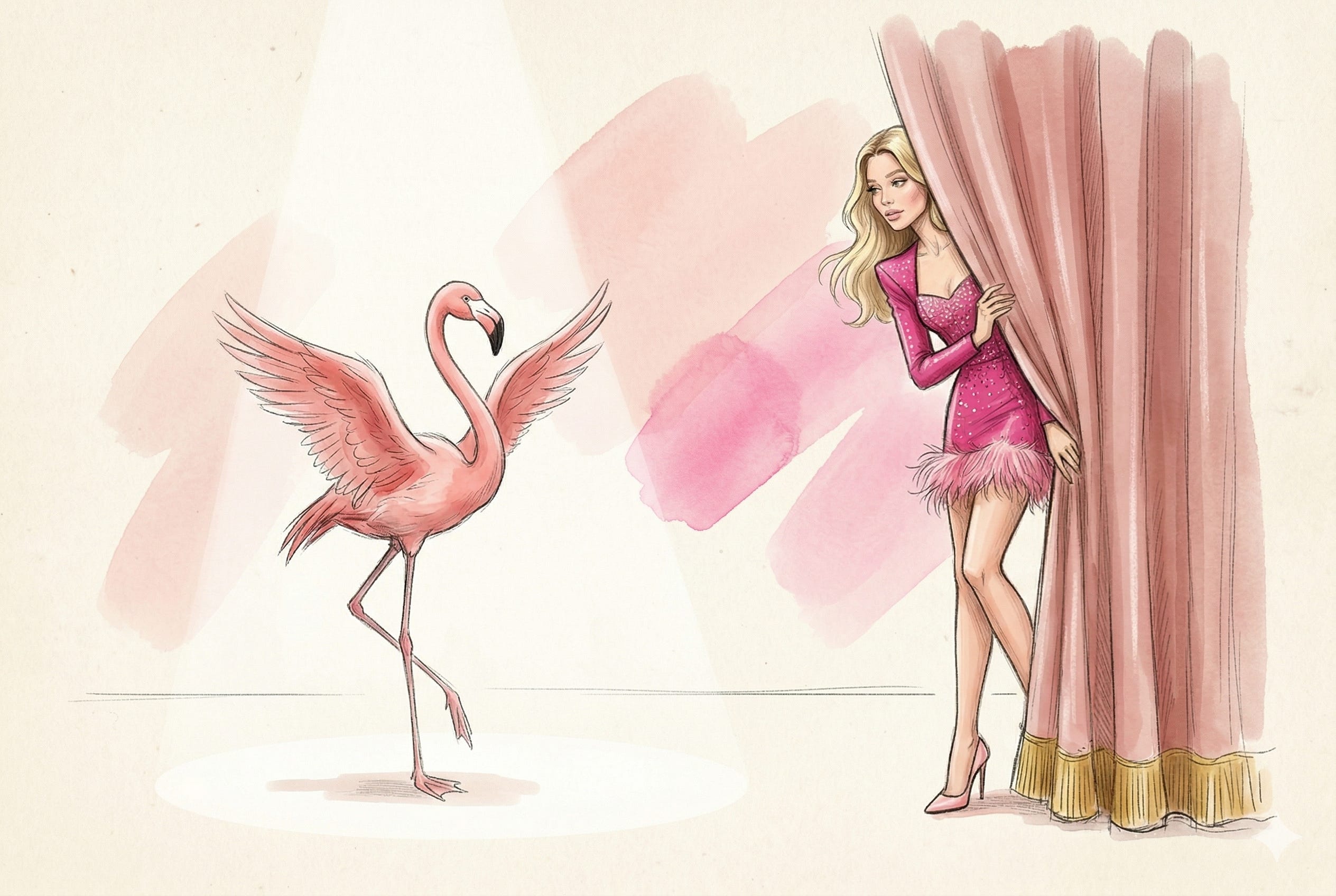
In search of my voice, my partner and I sat down and designed an entire universe of characters. No visuals yet, only personality profiles, and a whole universe of them. Each one had a distinct voice, a communication style, and a relationship with the audience. An owl that teaches AI. A dog that simplifies things. A cat that trolls everyone. A snake that speaks in puns. An octopus for developers.
And a flamingo.
The flamingo was the one I kept coming back to. She was sassy, stylish, supportive. She talked like a friend who’s always one trend ahead of you but never looks down on you.
So I signed up for Substack as Pinkie Prompts. A pink flamingo who gives AI tips. My profile picture was going to be a bird. I’m still not kidding. Here’s a screenshot for proof.
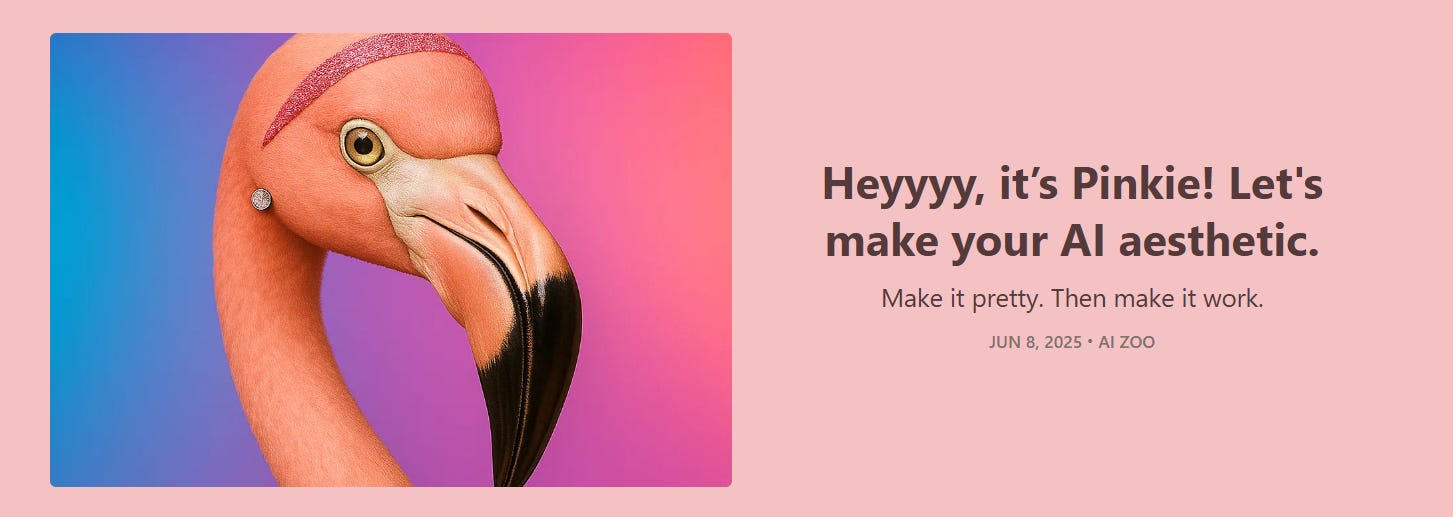
The flamingo lasted about two weeks. Substack is about human trust and I wasn’t going to get ahead as a bird. So I pivoted and the flamingo became the companion, the couture, the background signature, the visual brand. But the voice I’d profiled for that flamingo stayed. That became the Tone of Voice for my brand.
I soon realized I wasn’t inventing a character. I was choosing who I wanted to sound like. The animal was just the container for a voice I’d profiled using a personality psychology framework.
That personality framework is what I’m sharing with you today, so you can also feel “enough”.
Hey, I’m Pinkie. On this corner of the internet, we build your entire visual brand system using AI, one step at a time. If you’re new here: welcome. Honestly, this might be the best time to join. start here! 🩷🦩

What you’ll learn in this post:
What Tone of Voice actually means in branding and why picking 3 adjectives doesn’t cut it
How personality psychology builds a brand voice that’s actually you, even if you’ve never written a word
A free prompt to discover your brand personality type and generate a shareable image of it
The full 31-question framework, Claude prompt, and skill template (paid)

"Upload Your Posts" Doesn't Work If You Don't Have Posts.
There's great advice out there about building your brand voice with AI. Two of my favorites are Daria Cupareanu and Ruben Hassid, who are fantastic at this. Feed your past articles into Claude, let it study how you write, and boom, it extracts your patterns. If you've been writing for a while, that's genuinely the move. Go do it. I'll wait.
If you have past articles written in your own voice. Not by AI.
When I started AI Meets Girlboss, I had scattered client work and corporate presentations, but nothing that sounded like me. Nothing I’d want an AI to learn from. And I see this everywhere now, creators who start writing with ChatGPT because they don’t trust their own voice yet. The output is clean, competent, and completely generic. No character that stands out.
You can’t extract a voice from writing you haven’t done yet. So I used a completely different approach.
The Problem With “Just Be Yourself”
Everyone says “just be authentic.” Nobody tells you how. Especially when you’re staring at a blank Substack bio thinking: what part of myself do I even lead with?
In real life, you’re a thousand things. You’re funny at dinner but serious in meetings. You’re sarcastic with your best friend but warm with strangers. You care about fashion and also about spreadsheets. You’re a psychologist who watches TikTok.
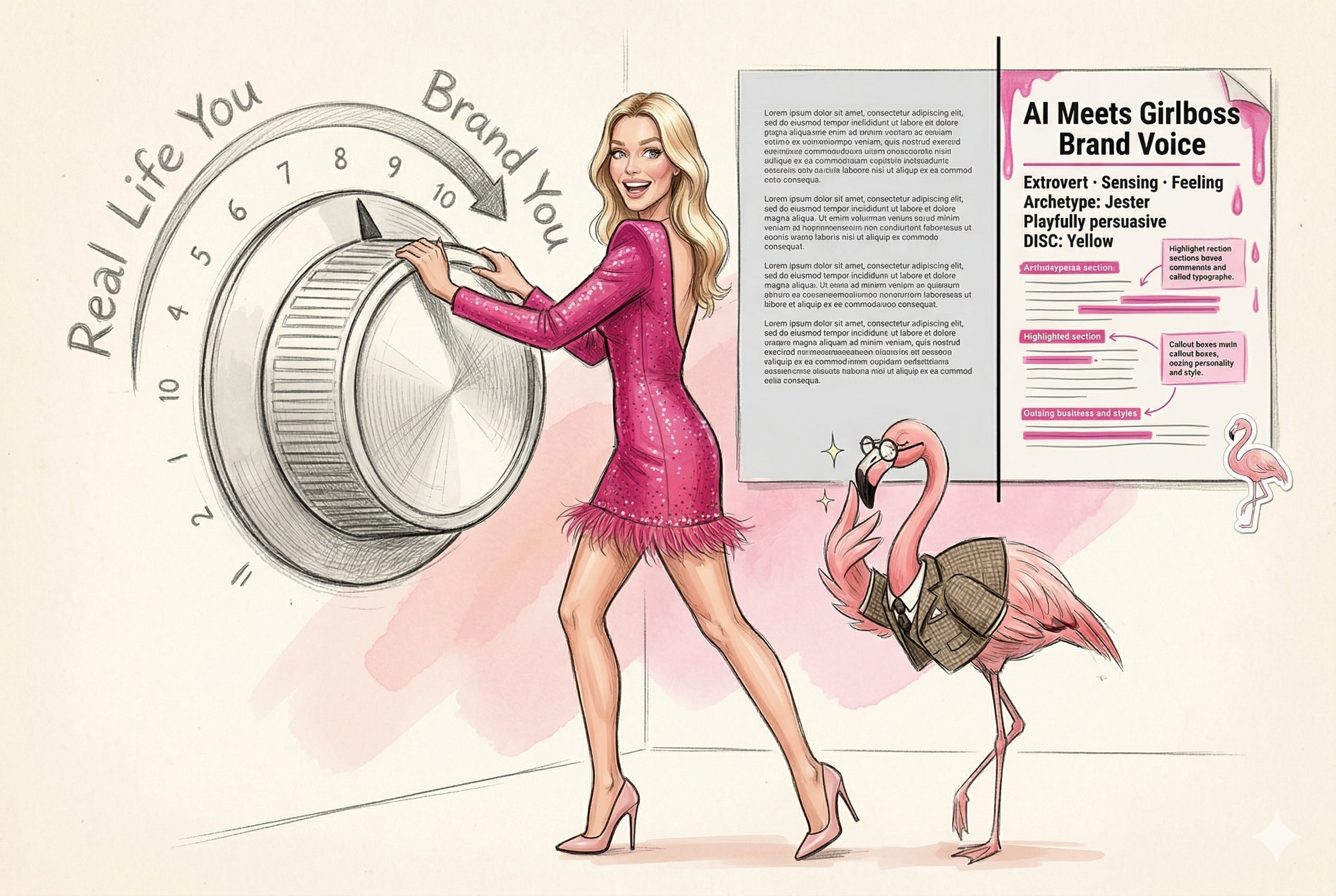
A brand voice is the best version of the parts that matter for this audience, on this platform, for this purpose. It’s a condensed signal.
Every branding guide tells you to pick three adjectives. “Warm, witty, professional.” Great. You and 47,000 other Substacks. Adjectives describe a voice after it already exists. They don’t build one.
So I used a different approach.
Finding your voice is a lot like finding your niche, it’s usually hiding in the overlap of things you already do. I wrote about discovering mine in My Substack Niche Was Hiding in Plain Sight.
I Put My Brand On The Couch To Develop My Voice.
I studied social psychology. And when I needed to figure out how this brand should sound, I didn’t open Google Docs and start free-writing. I pulled out the same personality frameworks I’d use to understand a person.
MBTI. DISC. Jungian archetypes. Bear with me.
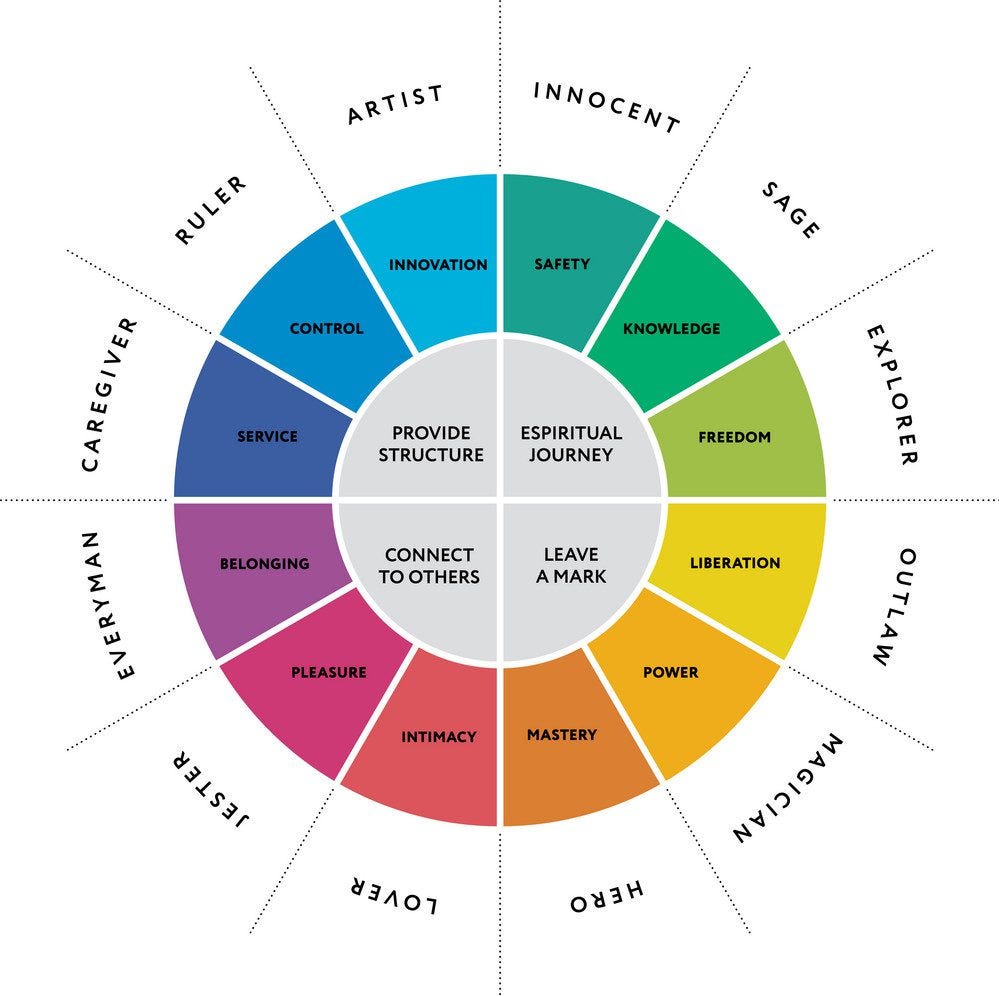
Here’s the logic: if you can profile the personality behind the brand, the voice writes itself. An ENFP Campaigner sounds completely different from an INTJ Architect. A Yellow DISC type communicates nothing like a Blue one. A Jester has different instincts than a Sage. These aren’t buzzwords, they’re actual decision-making tools.
So I profiled Pinkie. ESFJ, Yellow, Lover-Jester hybrid. Energetic, trend-aware, creative, connects through beauty, keeps things playful. The moment I saw that on paper? I knew how she’d open a post. What she’d never say. How she’d react to a snarky comment. Everything clicked.
She wasn’t a fictional character. She was me, filtered through a framework that made the important parts louder and the irrelevant parts quieter.
And that's the thing nobody tells you about brand voice: the best ones aren't invented. They're exaggerated. You take your actual personality — the way you already think, react, joke, explain things at dinner, and you turn the dial up. The parts that make you interesting? Those become your voice. The noise? Gets filtered out.
So the question isn’t “who should my brand be?” It’s way simpler than that.
Who am I already, and what does that sound like when I amplify it?
That’s what we’re mapping today. Your real personality, profiled with psychology, transformed into a voice AI can reproduce every single time. We’re doing it through AI asking us good questions, because better questions change the work you give AI.
Archetypes aren’t just a framework exercise, they’re how your audience reads you subconsciously. I explored how borrowing the wrong one can wreck your brand in The Personal Branding Traps Substack Creators Keep Falling Into.
OK, So What Is A Tone Of Voice For?
In professional branding, Tone of Voice is a system. It defines how a brand sounds across every touchpoint like emails, social posts, packaging, customer support, advertising. It’s the reason you can read a single sentence on Instagram and know it’s Taylor Swift without seeing the image itself.
Large brands spend months and six figures developing TOV systems. They hire strategists who write 40-page guidelines and train entire teams to write in one consistent voice.
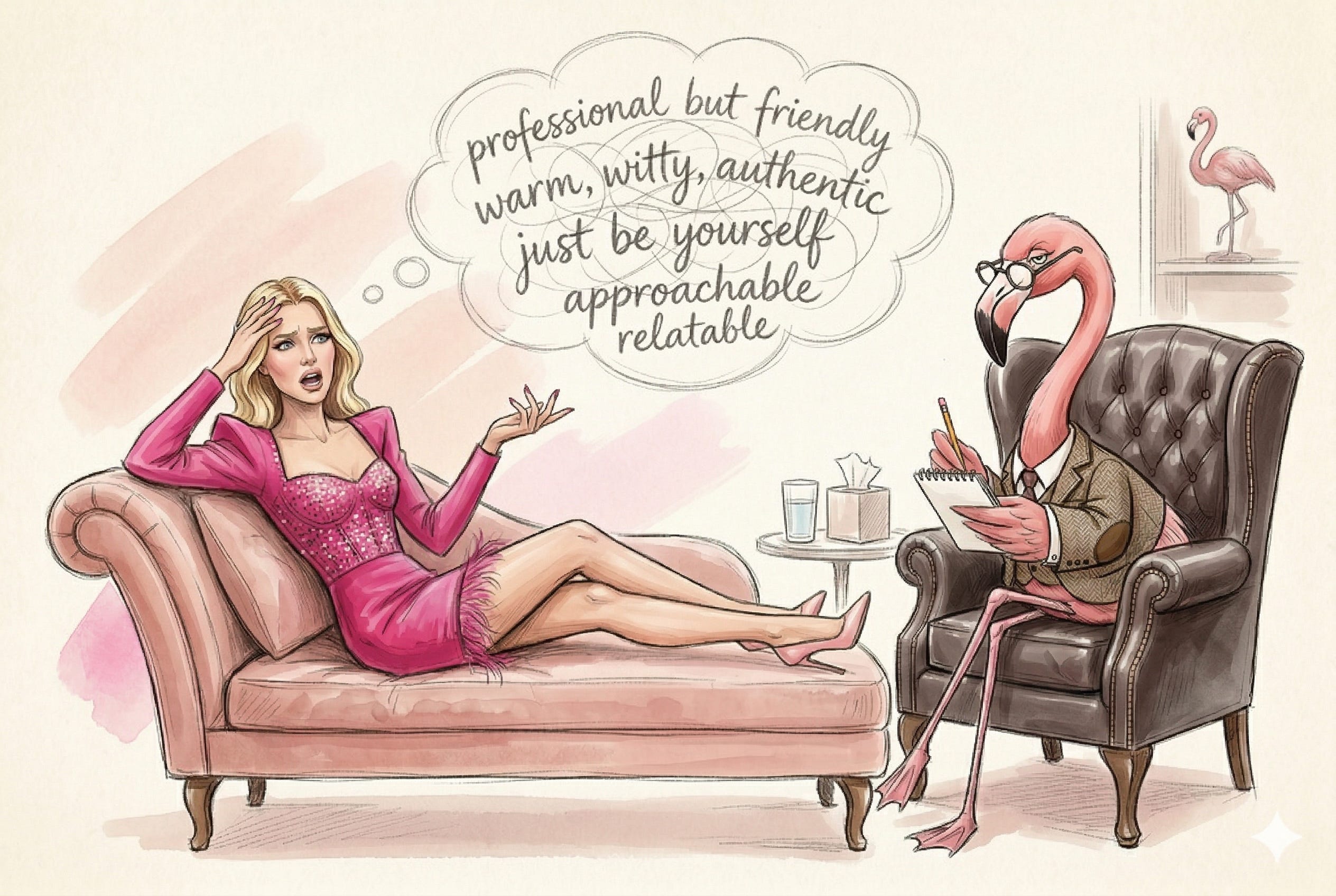
As a solopreneur, you are the brand. You don’t have a team to train, but you do need to train AI. Because without a Tone of Voice system your Monday post sounds different from your Thursday post, your email sounds different from your bio, and the moment you ask AI to write something for you, it defaults to “professional but friendly” just like everyone else.
What builds a voice is knowing the personality behind it.

Try This Now: Discover Your Brand Personality Type. (Free version)
I built the full framework into a 31-question Claude prompt behind the paywall. But here’s a taste you can try right now.
This takes about 2 minutes. At the end you’ll have your brand personality type and a shareable image. Tag me if you post it, I want to see your types. Here’s mine:
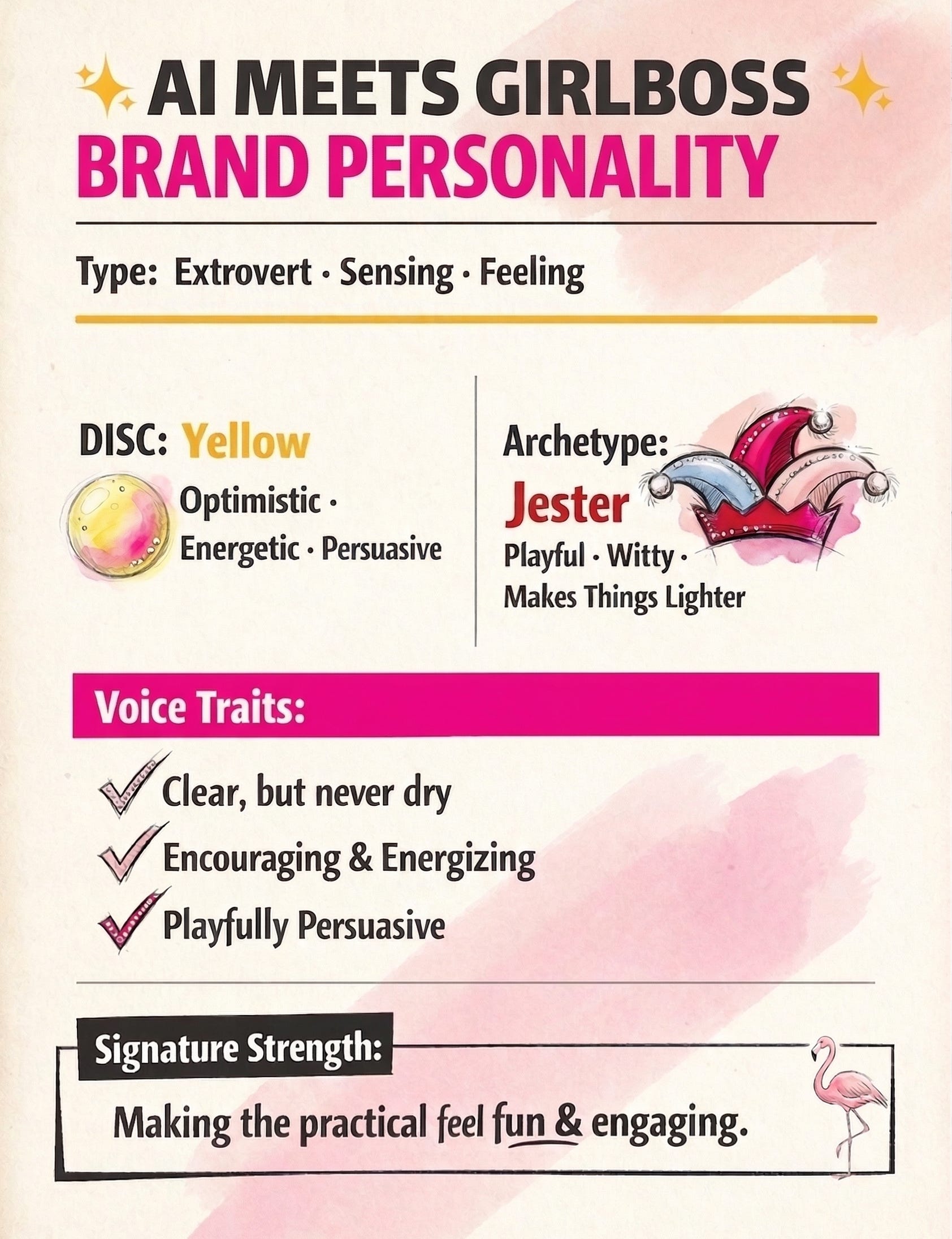
Paste this into ChatGPT (or any LLM with image generation):
I want to discover my brand's personality type. Ask me 5 quick questions, one at a time:

1. Ask me to choose between Extrovert vs Introvert energy for my brand (does it initiate or reflect?)
2. Ask me to choose between Intuitive vs Sensing (big picture or step-by-step?)
3. Ask me to choose between Thinking vs Feeling (logic-first or empathy-first?)
4. Ask me to choose a DISC color: Red (dominant), Yellow (optimistic), Green (caring), or Blue (analytical)
5. Ask me to choose a Jungian archetype from this list: Hero, Sage, Explorer, Creator, Caregiver, Jester, Lover, Ruler, Outlaw, Magician, Innocent, Everyperson. Give me a one-sentence description of each so I can pick.

After I answer all 5, give me:
- My brand personality type summary in 2-3 sentences
- 3 voice traits that naturally follow from this type
- 1 thing my brand should never sound like

Then ask me: "Want me to generate a shareable infographic card of your brand personality type?" If I say yes, generate a styled infographic card (clean, modern, bold typography) showing my brand personality type, my DISC color, my archetype, and my 3 voice traits. Make it something I'd post on Instagram or Substack notes.
There are so many writers I love on Substack with distinct voices, and I thought it would be fun to take four creators I’d recognize anywhere just based off of their writing and figure out their personalities:
Nick Quick who challenges norms and hacks the system with every post.
Neela 🌶️ who cracks me up every time with her blunt and bold tone.
Dallas Payne whose wit and intelligent storytelling helps me reflect.
The Strategic Linguist who manages to translate the most complex theories into practice.


In the Notes…
Tag me in a note with your brand personality snapshot! I will be restacking everyone, who tries the prompt and shares their brand personality type!
This is the starting point. The full framework behind the paywall takes you from psychology to Claude skill in 45 minutes, diving into your communication patterns, origin story, audience psychology, signature catchphrases, emotional reactions, and content guardrails. That’s 31 questions across 6 sections, and it ends with a complete Tone of Voice system + a Claude skill that makes AI write in your voice automatically. All behind the paywall.
Not ready to upgrade? The Voice Skill is also available as a standalone download on my Gumroad store.