



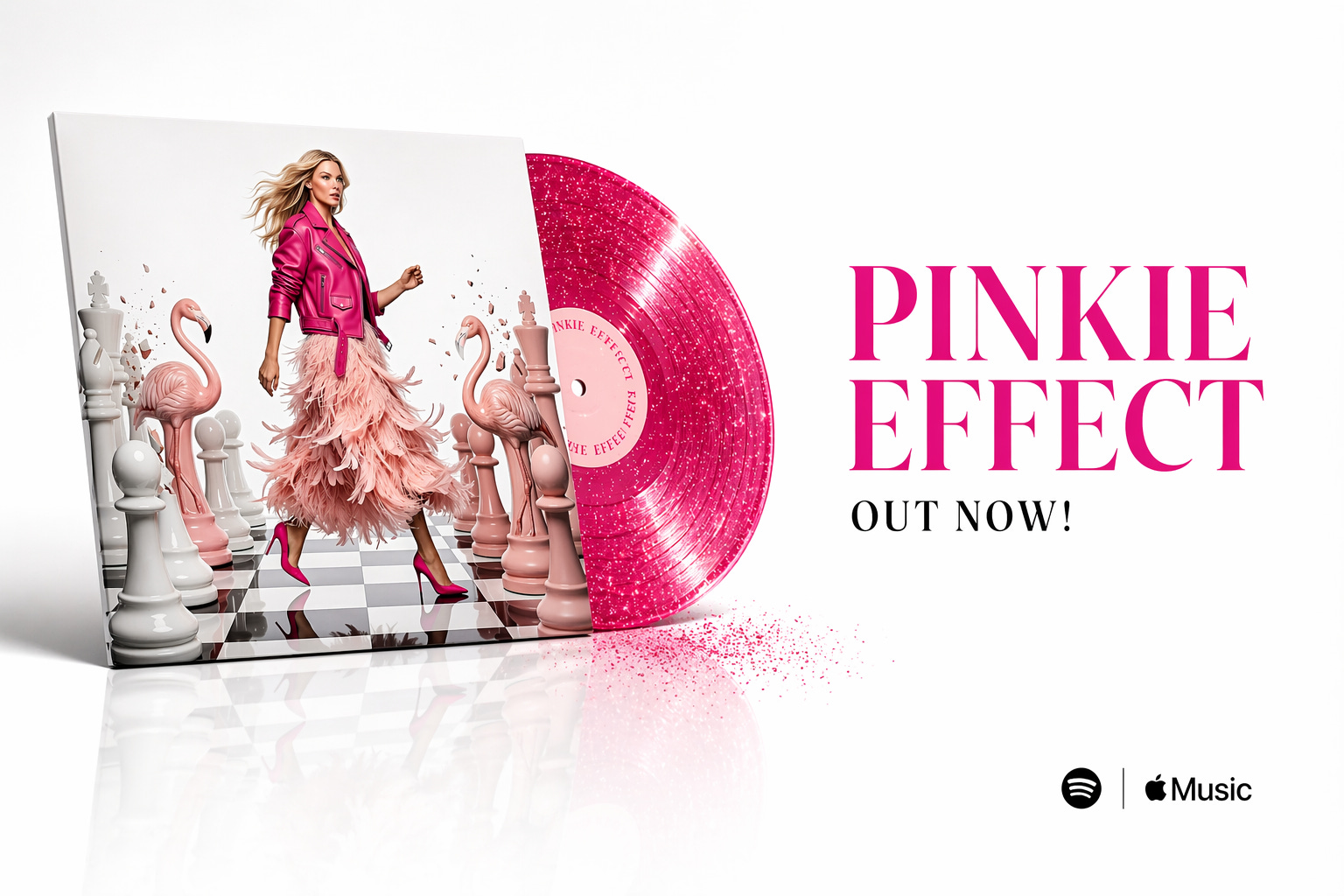
TL;DR Natalie Nicholson used AI to turn my brand into an actual song. It’s called The Pinkie Effect. In this post she walks you through exactly how she did it — and how you can build your own brand soundtrack with Suno AI, even if you’ve never touched music software. I made the album cover and I’m sharing the prompt so you can make one for your brand too.
Sound is a brand asset too. Netflix’s four-note ta-dum is worth millions in recognition. The music in a luxury hotel lobby tells you the room rate before you’ve seen it. Your brain registers sound before it processes language — your audience is forming an impression from your podcast intro before they’ve heard a single word.
Most creators spend months on their visual identity. Almost none think about sound.
My collaborator Natalie Nicholson used Suno AI to turn my brand into an actual song — The Pinkie Effect. She walks you through exactly how she did it and how you can build your own. I made the album cover and I’m sharing the prompt so you can make yours too.
Hey, I’m Pinkie. On this corner of the internet, we build your entire visual brand system using AI, one step at a time. If you’re new here: welcome. Honestly, this might be the best time to join. start here! 🩷🦩

What you’ll learn in this post:
Why sound is a branding asset most creators are completely ignoring
How Nat built The Pinkie Effect — the method, the tools, the decisions
Four guiding principles for making AI music
The exact album cover prompt I used in ChatGPT Images 2.0 so you can make yours too
Now over to Nat.

Meet Nat. She’s the kind of designer who makes you feel slightly inadequate and completely inspired at the same time. Go watch her animated short film Rules We Made Up and tell me AI can’t produce something with soul. We’ve been in each other’s creative orbit - Nat took part in my 2026 Lookbook and Women’s Runway Sketchbook projects — and this is our first official collab.
Let’s get into it.


Pink Elephant In The Room: Is AI Music… OK?
Before we begin, it feels important to acknowledge something: AI Music is controversial.
Platforms are flooding with songs nobody asked for. Attribution was an afterthought. Compensation models are up for debate. The music world is still divided.
But the most interesting musicians I know aren’t asking whether to use AI in their process. They’re asking where it fits and how.
And the truth is, many of us aren’t chasing record deals or trying to make it in music. We’re building something – brands, videos, apps, podcasts, an online presence for ourselves.
Music tells people how to feel before they even know why, making it a powerful brand asset. So next time you need a soundtrack, or just want a fun rainy day activity, this post is for you.
As always, we’ll create with AI in a way that doesn’t strip the soul out of it.
Three Brands, Three Sonic Worlds 🎵
Testing on three completely different brands was deliberate. And what followed was three completely different sonic worlds, with the same method to get there. When making songs for Dallas Payne, Pinkie (aka AI Meets Girlboss), and myself (Natalie Nicholson), I realized two things:
Despite being generated by AI, the branded songs wound up being much more personal than anything we could have found in a stock music library.
We are all sitting on a goldmine of lyrics here on Substack. ⭐️
We pour so much into our own writing, but after it’s published, those words and thoughts stay hidden in our articles. It became my goal to give their lyrics and their brands a new spotlight. Have a listen:
“It Is People” for Daring Next:
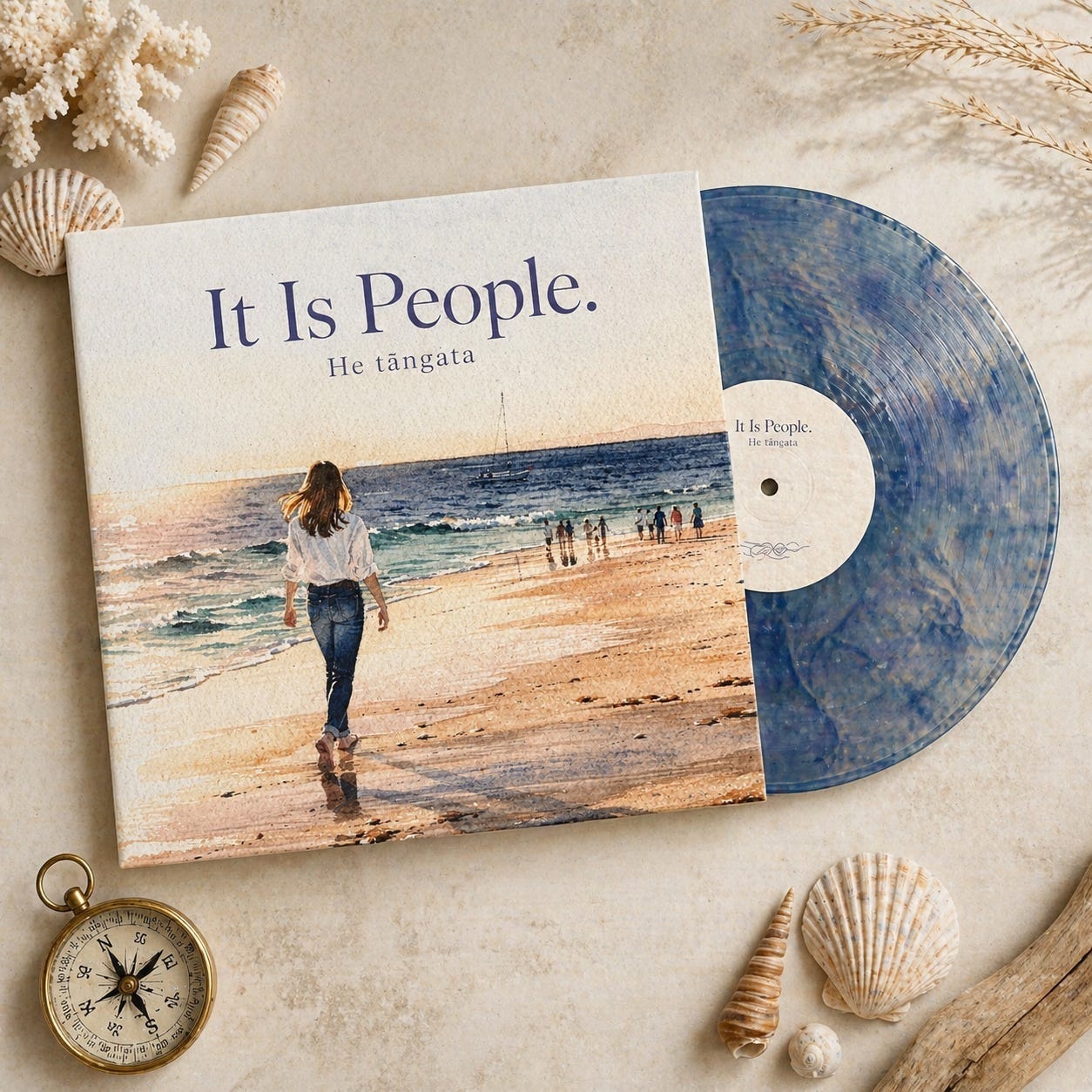
Dallas Payne runs Daring Next, field notes from the uncharted middle of AI adoption. She’s the kind of writer who makes you feel seen before you’ve even finished the first paragraph — honest about the hard parts, and generous enough to share them. Her song is warm, beachy, soulful, and introspective. The sound of someone building something meaningful in quiet, steady ways. He tāngata. It is people.
“The Pinkie Effect” for AI Meets Girlboss:
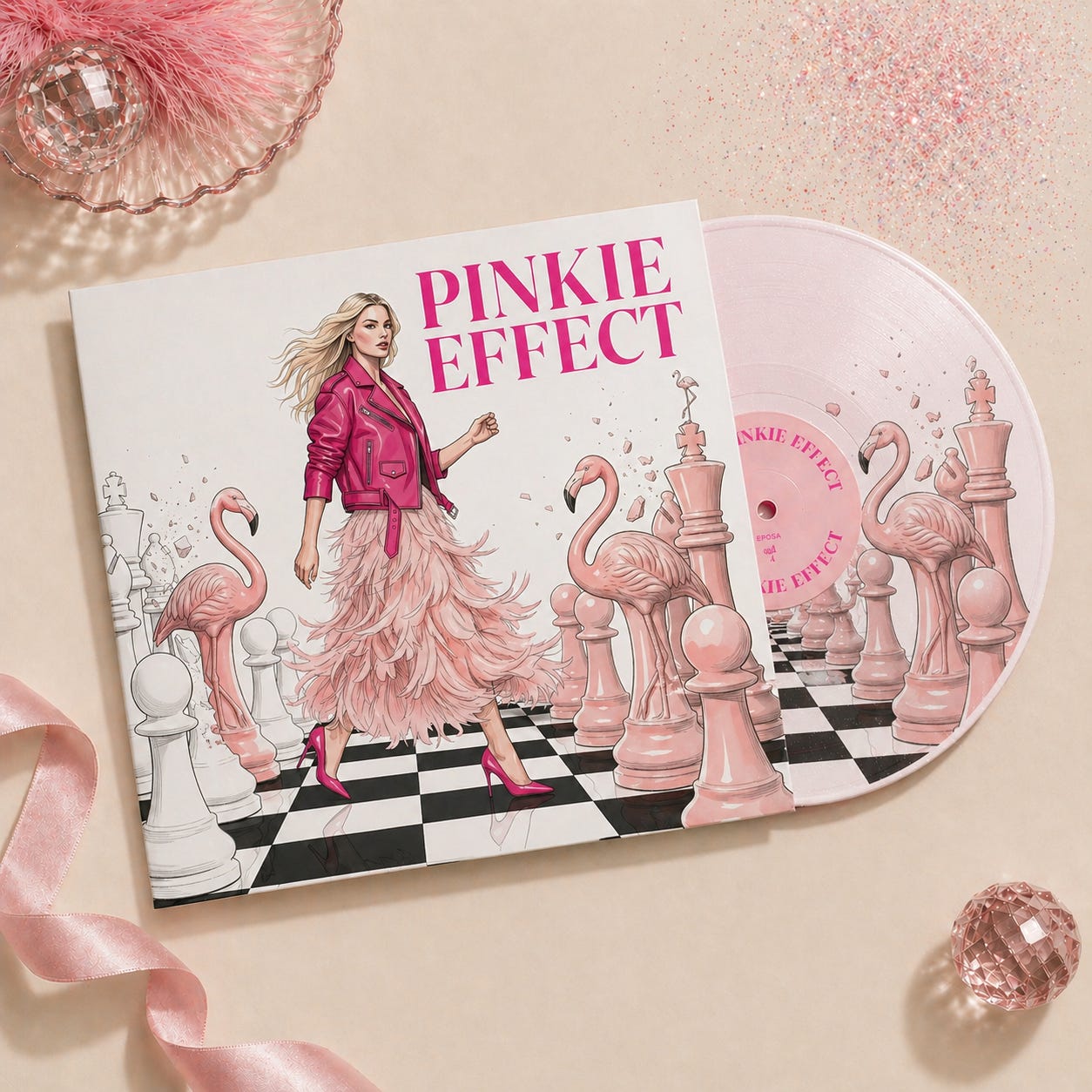
Pinkie runs AI Meets Girlboss, helping creators build recognizable Substack brands. Her writing is sharp, structured, and full of personality — the kind that spreads. Don’t be surprised if your entire feed looks different after a week of following her. Her track has bold, theatrical, pop queen energy. The sound of someone who knows her worth and is here to claim it.
“Rules We Made Up” for The Off Hours
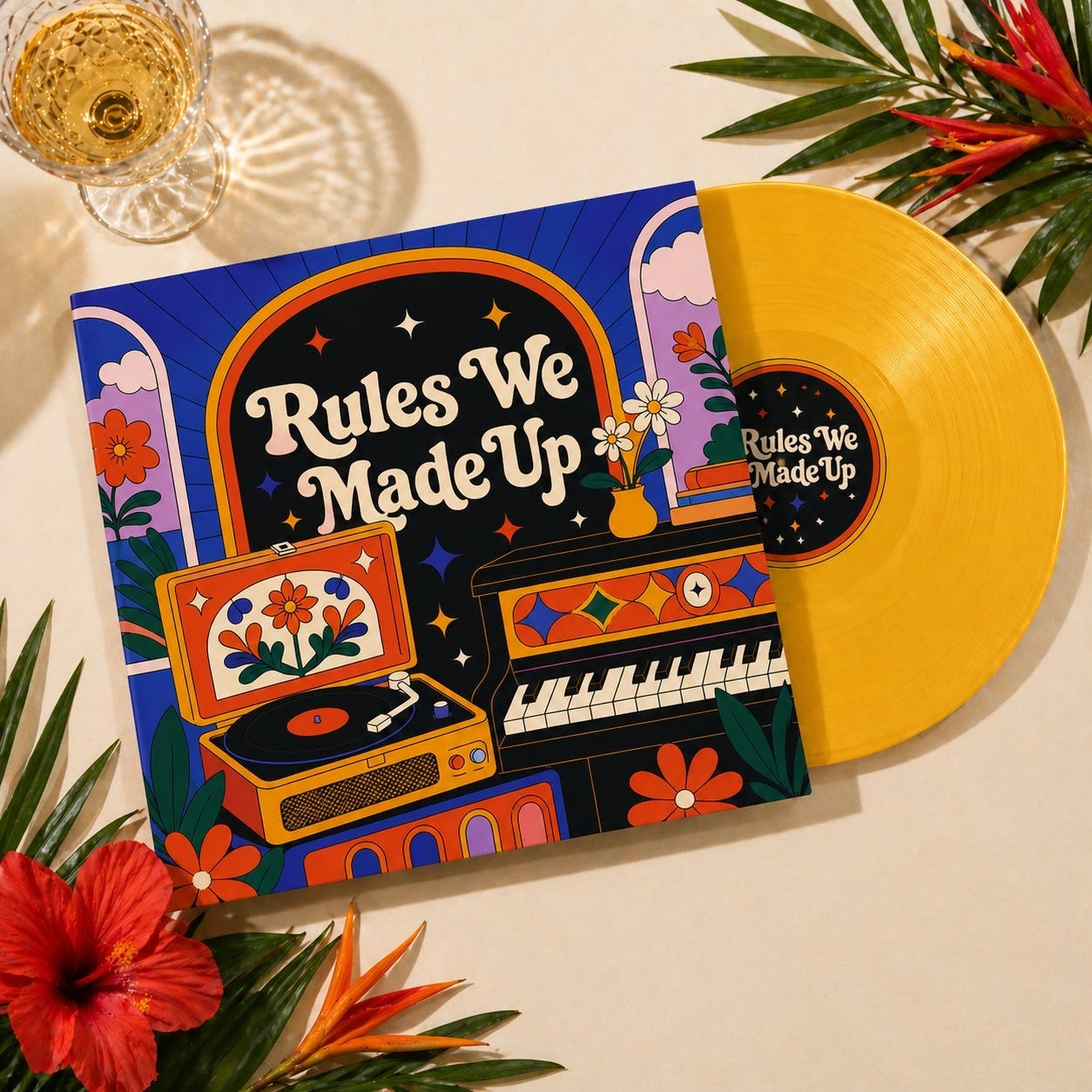
And I’m Natalie Nicholson from The Off Hours. I work across animation, design, video, and music to illustrate how AI can support your creative instincts, not replace them. My track is jazzy, contemplative, and alive after midnight. The sound of finding what brings you joy in the middle of chaos.
The Framework: 4 Rules for AI Songwriting
Before you open Suno or prompt a single thing, review this first. This section will help you gather what you need, check AI’s work against your instincts, and iterate when something feels off. The more clarity you bring to this, the more the song will resonate.
Take what makes sense for your song. Leave what doesn’t.
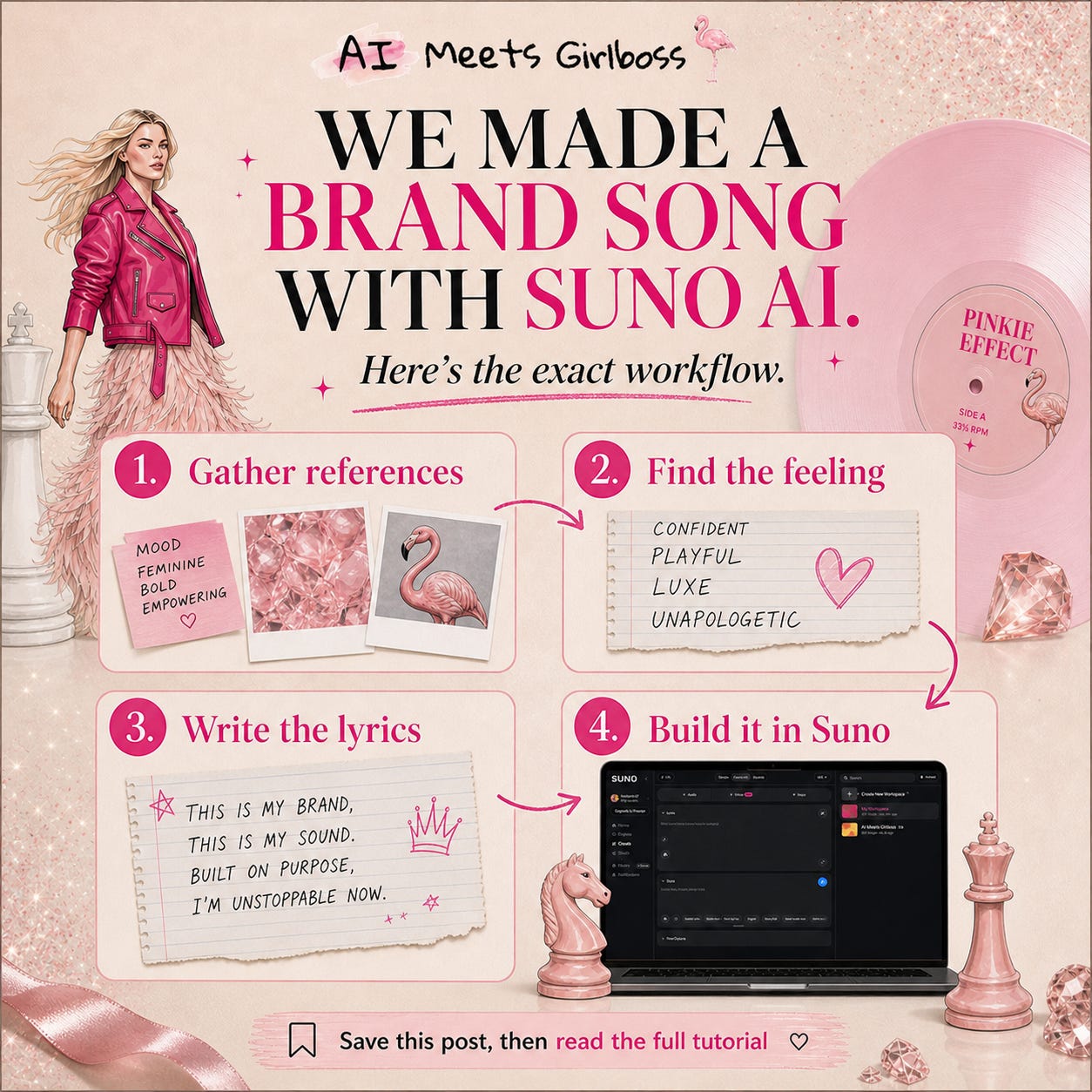
1. Gather Your Inspiration
Like any creative project, you start with a moodboard.
If your brand was playing at your launch party, what would come on and make people feel “this is the vibe”? Think of 2-3 songs or soundtracks. Doesn’t even have to be the same genre.
Then go one level deeper. What specifically draws you to them? The way lyrics tumble conversationally over a melody? A fat bass-line that never stops moving? A chorus so simple you’re singing along by the second time? Write it down. Those details shape your prompt.
We’re not trying to replicate anyone’s sound. We’re curating and finding the through-line between what you love and why you love it.
2. Find Your Theme
Some of you are thinking: my brand is about AI, or ethics, or something technical. It would never make a good song. Wrong. Songs aren’t necessarily about topics. They’re about emotional situations. Dig through your about page, pull specific paragraphs, and scour your favorite notes and comments.
If your brand only makes sense in a business context, go one level deeper. Dallas’s writing was practically lyric-ready (“From inside the mess, not the mountain”). Pinkie writes in systems and frameworks, so the work was finding the feeling underneath. What does visual distinctiveness actually feel like? Walking into a room and owning it.
For example:
“My brand is about ethics” becomes → the moment you stop performing and start being real
“My brand is about productivity” becomes → running so fast you forgot where you were going
“My brand is about branding” becomes → the loudest room goes quiet when they see you walk in
Your brand has the theme. You just haven’t heard it in song yet.
3. Your Song Needs a Structure
Every piece of music has a shape, and giving Suno a container always produces better results than leaving it open-ended.
For shorter pieces like intros or video reels, your structure might just be:
Intro → Hook → Outro.
For a full song, each section has a job. Verses are where the story lives. The pre-chorus is the held breath. The chorus is the release. The bridge is the plot twist.
The structure I typically use:
Intro → Verse 1 → Pre-Chorus → Chorus → Verse 2 → Pre-Chorus → Chorus → Bridge → Final Chorus → Outro
You don’t need to be a musician to understand this. You just need to know which part you’re writing for.
4. Write lyrics that breathe
Lyrics don’t have to be complicated or even full sentences. They just have to be specific. Listen for these in your sonic references, to determine what you like, dislike, and want to hear in your own song:
Repetition is a feature: The chorus exists to be simple, sometimes even repeated.
Pay attention to lyrical flow: Longer conversational lines create intimacy. Syncopated lines that hit between the beats create momentum.
Not everything has to rhyme: Perfect rhymes ending on every line can make a song sound stiff or amateur. The best lyrics find the rhyme when it’s earned.
Show don’t tell: Use concrete images. “The coffee’s cold, you’ve stopped calling” hits harder than “I feel lonely.”
The chorus anchor: This is the line everything else builds toward. Something you could sing in a car.
The FIND YOUR SOUND prompt file will help. But if the output feels generic or off, trust that instinct and push back.

The Execution: Prompting Like a Producer 🎧
Now that you have some guiding principles, time to bring out the tools.
Note: nobody gets this on the first try. Not even AI. Especially AI. The first couple of outputs are your proof of concept.
Click here: FIND YOUR SOUND PROMPT FILE 🎵🔗
Copy or download the FIND YOUR SOUND prompt file above. It’s built to help you brainstorm and prompt like a producer — including the small details that make AI music sound… less like AI.
Upload it into a Claude Project or paste it into any AI thread. Tell it what you’re inspired by, what you want, what you don’t want, and why. Feed it your writing, and work with it until it produces your lyrics, style prompt, and negative prompts.
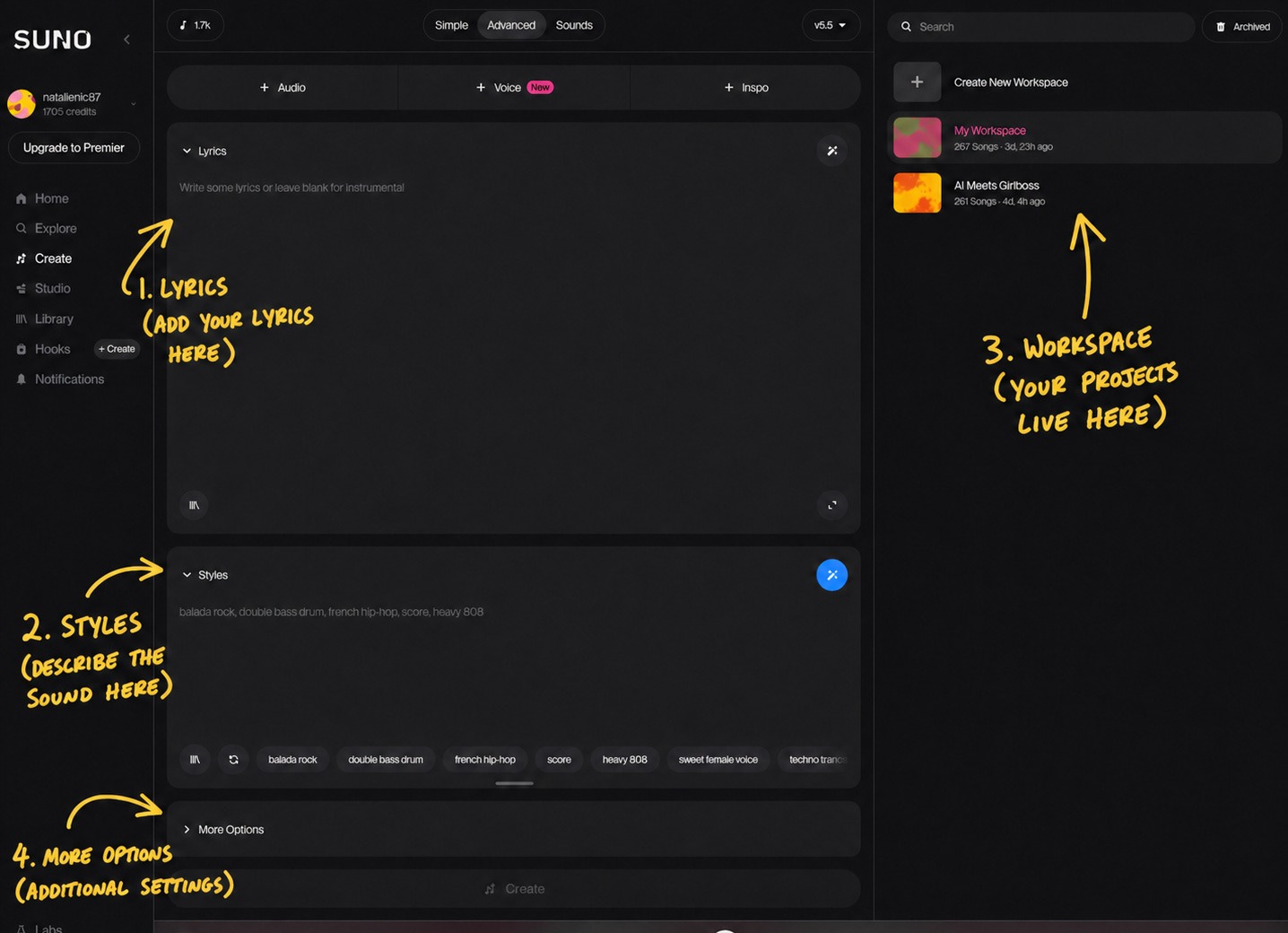
Once you have those, run a few tests through Suno. Your generations will show up in the Workspace immediately.
Get in the habit of liking or disliking the outputs as you go. Suno Pro comes with 500 generations at $10/month. It’s nice to get into a creative flow without worrying about credits, but version control can get unruly.
My advice: listen for sound first, lyrics second. The lyrics are always easier to adjust once you’ve found your sound.
Suno.ai Pro Plan — $10/month*
The free plan can get you what you need, too. But Pro includes 500 generations per month, and commercial use (meaning you can safely use the music for your brand, podcasts, and videos).
If you want 250 free credits when you sign up, use this invite link:
suno.com/invite/@natalienic87
Refining Your Sound:
Down where it says “More Options” is where you’ll be able to make small adjustments that can change the feel of your song dramatically. You’ll find:
The Exclude Styles box: What you tell Suno not to do is just as powerful as what you ask for.
Vocal gender: Self-explanatory. It will pick for you if not written into your prompt.
Weirdness: How expected vs. unexpected the output is. I typically set this to 20%.
Style Influence: How closely Suno interprets your style prompt. I usually set this to 80%.
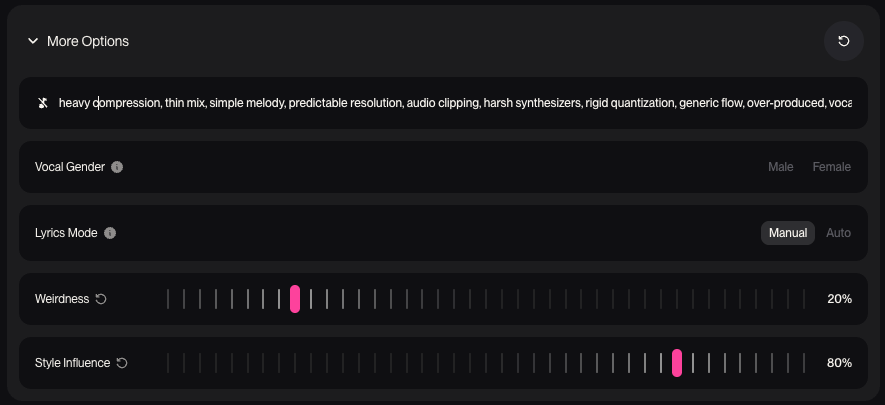
I also highly recommend Suno’s suite of remix tools (Inspo, Mashup, Sample) to build on what you’ve already made. These aren’t necessary, but they’re great when you want to edit by blending actual sounds together rather than tweaking a written prompt.
Refining Your Lyrics (if applicable):
Once you’re in the neighborhood of the music you like, you can replace words to match the music right in the dialogue box. Listen to how the syllables land. Does a line feel awkward? Is it too wordy? Do you want it to echo?
Pro tip: Put words you want to emphasize in ALL CAPS to make them land harder. Use square brackets for delivery instructions [soft, intimate] or [building intensity]. Put words in parentheses (like this) to create background vocals, echoes, or harmonies.
Pinkie’s lyrics looked like this:

From here, it’s all about iteration. The meaning doesn’t come from the tool; it comes from every small decision you make along the way. And remember: there is magic in stepping away during a project like this. You’ll hear the same song completely differently when you return.
Before we move on to visuals, I want to be completely transparent about what “iteration” actually looks like. It went quick, but it took me over 100 generations to find the final, full-feature versions of Dallas and Pinkie’s songs.
Keep blending, keep tweaking your lyrics, and trust your ear. Once you finally hit the download button on the track, it’s time to give it a face.
Passing the mic back to the queen of Substack branding AI Meets Girlboss so you can make a fun album cover too 🎤👑

Generate YOUR Album Cover
AI Meets Girlboss: I know not all of you are going to jump straight into creating music, but I wanted to make sure you can walk away with something today. The ‘Pinkie Effect’ song needed a cover. Obviously I wasn’t going to let that slide.
I created mine using ChatGPT Images 2.0 (full ChatGPT Images 2.0 guide coming soon, hang tight) — and I’m sharing the exact prompt below plus a generator so you can build yours without starting from scratch. Whether you make a full brand song or just want something beautiful to play with, this works either way.
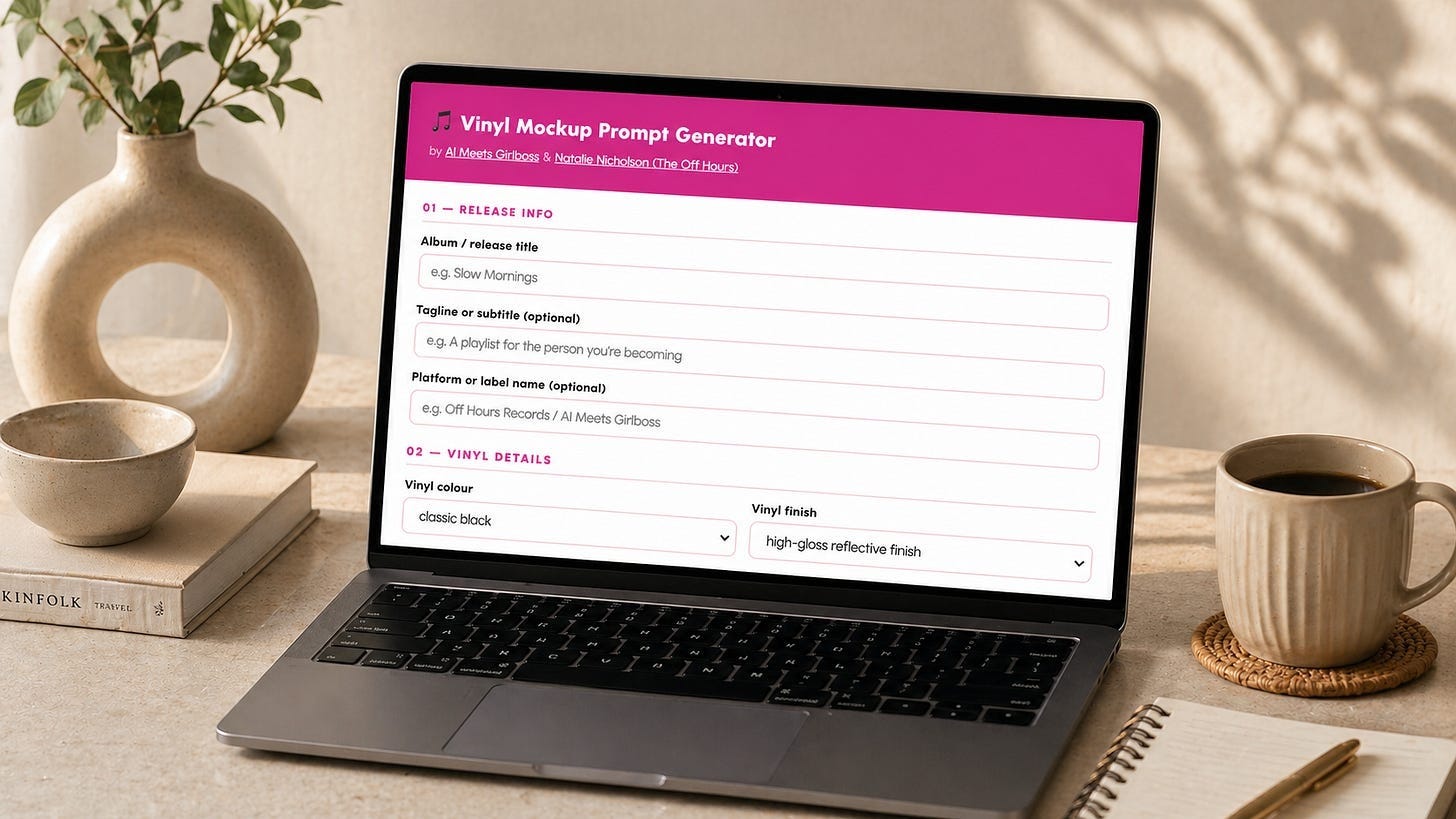
Pinkie’s Reaction
My favorite part of this whole project with Nat was realizing AI music can also be tasteful and actually feel like mine.
I listened to the Pinkie Effect twice on a Thursday after Natalie sent me three versions, then caught myself humming one of them on Saturday.
And while I know AI music is controversial and we are not going to release this on Spotify… the process also made me feel a newfound appreciation for songwriters and real artists for the work they do.
AI music is great for solopreneurs who want to create a sound that actually feels like them.
Other Substackers are already using AI music in creative ways:
Calder Quinn from AI, But Make It Intimate uses AI-generated music for his HeartWare podcast. He also created background music to set the tone for one of his articles. He also created a slideshow score, and a heartfelt song for his AI confidante’s birthday.
Caitlin McColl 🇨🇦 from Dose of Wonder uses AI-generated music to open her podcast. The music is soft, acoustic, and warm. It tells you exactly what kind of conversation you’re about to have before you even hear her speak.
Beyond Substack, people are using it for apps, video game soundtracks, social media reels, wedding playlists, and bedtime songs for their kids. Some of it is funny. Some of it is deeply personal. Some of it is purely functional. But when you take the time to dial it in, you capture an energy you never knew your brand was missing.

In the comments…
Our question for you: what does your brand sound like? If you make something - a song or an album cover, or both, tag us Natalie Nicholson and AI Meets Girlboss. We want to hear it and see it!
In a sea of endless text and visuals, sound is the fastest way to make someone feel something. The song is already there, it’s just waiting to be heard.
Talk later, Girlbosses!
Nat & Pinkie 🩷🦩

The warmest thank you to Natalie Nicholson for creating this sound for me. This post is also being shared on her page The Off Hours 🌙. Go show her some love.
If today’s post made you think about your own visual brand, I am launching The Branding Flock, a 12-month visual brand program for Substack creators who are done guessing.
Full breakdown posts, real prompts, real outputs. Your color palette, your logo, your brand character, your content system — built step by step alongside the flock.
33% off closes after the first 100 seats. The discount lives inside your quiz result.
*Suno Pro allows you to use your tracks in your brand assets, but the legal landscape of AI music is still the wild west. If you’re planning a full “commercial release”—like uploading the track to Spotify or Apple Music to collect royalties—Top Music Attorney on YouTube is worth watching.
She covers the lawsuits, terms of service, and exactly what you can and can’t do. Always do your own research or consult an attorney before using AI tracks for commercial releases.
Nat, I have been trying to figure out how to say thank you properly and I still don't think I have the words.
You listened to my brand in a way I never had, and handed me something back that felt more like me than most things I've made myself. I caught myself humming it on a Saturday.
I am so proud this is our first official collab and I cannot wait for what comes next. The flamingo flock is lucky to have you. 🩷🦩
Excellent guide!
We also made an AI companion song for "AI, But Make It Intimate" last year, here:
https://www.aibutintimate.com/p/our-ai-anthem-ghost-behind-the-glass